300 Baud · the walled gardens
The walled gardens
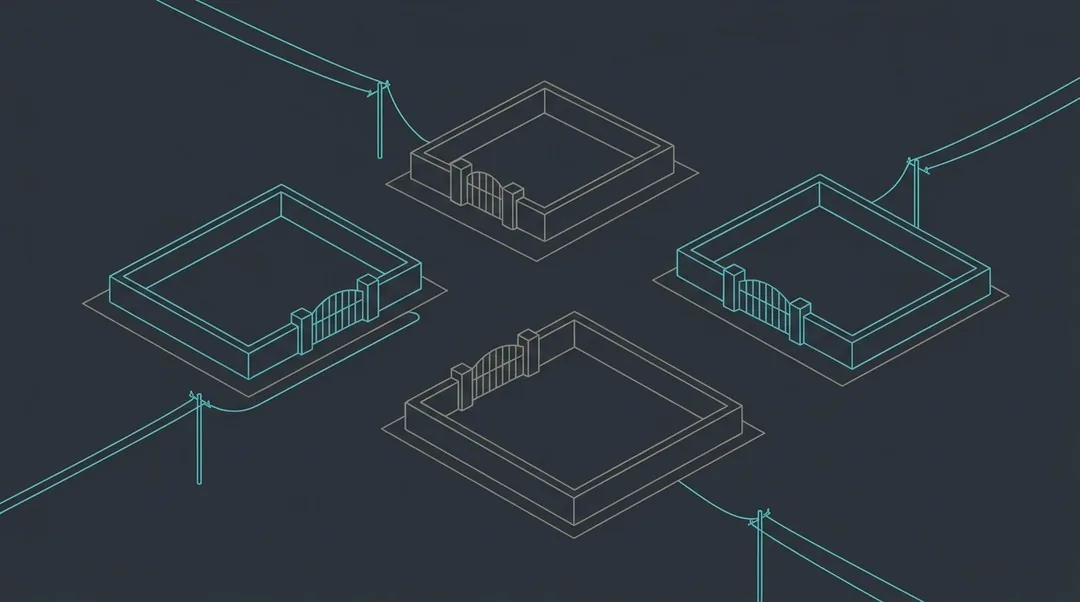
Before the internet was something a household could buy, getting online meant subscribing to somebody's private network and paying for the time you spent inside it. Not paying for a connection to everything. Paying to be in one place, which had its own news, its own shops, its own forums and its own weather, and no way out.
That arrangement lasted about fifteen years and then collapsed in roughly eighteen months. What killed it was not a better network. It was a change in how the bill was calculated.
The meter
Why there was a clock in the corner of the screen
You paid by the hour. Almost all of these services began that way — Prodigy is the exception below, flat-rate from launch — and the number moved while you read. Terminal programs put a session timer on screen because it was the most useful thing they could show you, and the sensation of watching it while deciding whether to open one more message is the defining experience of the era. It is not nostalgia to say it changed behaviour. It was designed to.
CompuServe's rate fell from over ten dollars an hour in the 1980s to about $1.95 by the mid-1990s, which sounds like a bargain until you notice it is still a taxi meter. Some tariffs charged more for a faster modem, on the reasonable logic that what was scarce was the port you were occupying rather than the bits going through it.
Everything downstream of that follows. Messages were composed offline and uploaded in a burst. Whole categories of software existed to log in, grab everything new, and log out, so you could read at leisure without paying to think. The culture of the walled gardens was shaped by a pricing decision more than by any technology in them.
What you were actually paying for
A place, and it is worth being concrete because "online service" has stopped meaning anything. You dialled in and got forums organised by subject with staff who moderated them, an encyclopedia, airline schedules you could actually book from, share prices, wire-service news, software libraries, and mail to other subscribers. The service ran all of it. There was no elsewhere to link to.
And you reached it on a local call, because the packet-switched networks that did the carrying had dial-in nodes in most cities of any size. The long-distance bill that made bulletin boards local institutions was the thing the commercial services had already solved, and it is most of what subscribers were paying for.
The gardens
CompuServe, which was first and behaved like it
The oldest of them by a decade, and for most of its life the biggest: it passed three million members in April 1995, still the largest of its kind at that point. Its forums were its real product, and they were genuinely good, moderated by people who knew the subject and populated by professionals who were there because that was where the expertise was.
Its weakness was that it was built for people who did not mind a command line and a bill. It looked like what it was, a timesharing service with a menu on the front, and when the competition arrived looking friendlier and costing a flat rate, being right about forums did not save it.
Prodigy, which was a joint venture and looked like one
A partnership between IBM and Sears, which explains a great deal. It had 465,000 subscribers by 1990, second largest at the time, and unlike its competitors it charged a flat monthly fee from the start — $9.95 at launch, raised to $12.95 later — with advertisements on screen to make up the difference. That is the model the entire consumer web eventually adopted, arriving about a decade early and to general irritation.
It also had graphics when the others had text, and it was slow, because graphics at 2400 bits per second are slow. Then it moved away from flat pricing in 1993, which annoyed the subscribers it had, and it moderated its message boards heavily enough to become a story in itself. Two retail-and-mainframe giants had built something with the instincts of a shopping catalogue, and its users wanted a community.
America Online, which understood that it was selling a place
It descended from Quantum Link, a service for Commodore machines, and it arrived last of the three with much less to offer technically. What it had was an interpretation of the product that turned out to be correct: people were not buying data, they were buying somewhere to be. Chat rooms, instant messages, screen names, a friendly front end, and an onboarding process so aggressive that its installation disks became a cultural artefact in their own right.
The thing to understand about AOL is that it won on the part everyone else treated as decoration. CompuServe had better forums and Prodigy had deeper corporate pockets. AOL had the sense that a message from a friend arriving while you were online was the whole thing.
MSN, which arrived late with the largest possible advantage
Microsoft launched its own service alongside Windows 95, with an icon on the desktop of what was rapidly becoming every consumer computer on earth. On paper that was unanswerable.
It was not, because the timing was wrong in a way nobody could have fixed. MSN launched as a walled garden in the same eighteen months that the web made walled gardens pointless, and Microsoft spent the following years turning it into an internet service and then a portal. Being preinstalled is a colossal advantage when the question is which garden to join. It is worth much less when the answer turns out to be none of them.
The month the meter came off
October to December 1996
MSN announced unlimited access for $19.95 a month in October 1996. AOL moved every subscriber to unlimited at the same price from the December billing period. Within a quarter, the hourly rate that had defined consumer online services since the 1970s was gone.
What happened next is the part worth remembering, because it is a capacity lesson rather than a business one. When time stopped costing money, people stopped hanging up. Sessions that had lasted twenty careful minutes became all evening, the modem pools were sized for the old behaviour, and subscribers spent the winter listening to busy signals. You cannot change the price of a thing without changing how much of it people use, and the amount of it you need to have.
Why the gardens lost, which is not the obvious reason
The usual telling is that the web was better and the walled gardens were doomed. That is true in outline and it misses the mechanism.
A garden's value to a subscriber was everything inside it, so its incentive was to have more inside it than anyone else, and that is a race that can be run. What it could not survive was the arrival of a place where the content was made by anybody, cost the service nothing, and could not be licensed exclusively. The moment a local call reached the whole web instead of one company's network, the service's own material stopped being an asset and became an expense.
They all tried the same manoeuvre, which was to become the front door to the internet rather than an alternative to it. Some version of that worked for a while. None of it worked for long, because a front door is a much less valuable thing to own than a walled garden, and the ones who owned the door found that out over the following decade.
The shape of it came back
It is tempting to file all this as a dead end, and it would be wrong. The walled garden's actual proposition was that a single company provides the place, the content, the identity, the payment and the moderation, and that leaving is difficult because everything you have is inside. That description has not stopped applying to anything. It only stopped applying to companies that charge by the hour.
The part that genuinely died is the meter. Nobody has managed to bring back per-minute pricing for consumer access, and the reason is the winter of 1996 to 1997: the moment one competitor stops counting, the clock in the corner of the screen becomes unsellable.
Sources
- Federal Trade Commission, “America Online, CompuServe and Prodigy Settle FTC Charges Over ‘Free’ Trial Offers, Billing Practices”, May 1997 — the meter, documented by the agency all three of them had to answer to. It is the source for how connect time was billed rather than how it was advertised, down to the rounding: a minute could be billed as four. It says nothing about the flat-rate dates above, which rest on the encyclopaedia entries below.
- CompuServe, for the hourly rates and for passing three million members in April 1995.
- Prodigy, for the IBM and Sears partnership, 465,000 subscribers by 1990, and the flat rate it moved away from in 1993. The $9.95 launch price and the later $12.95 come from contemporary reporting: the Washington Post of 28 November 1988 and the Los Angeles Times of 7 November 1990.
- AOL and Quantum Link, for the descent and for the December 1996 move to unlimited at $19.95.
- MSN, for the Windows 95 launch and the October 1996 unlimited announcement.
- Tymnet and Telenet, for how a national service was reached on a local call.
Back to the modem · The bulletin board world · Every speed, 110 baud to fibre