300 Baud · every speed
110 baud to fibre
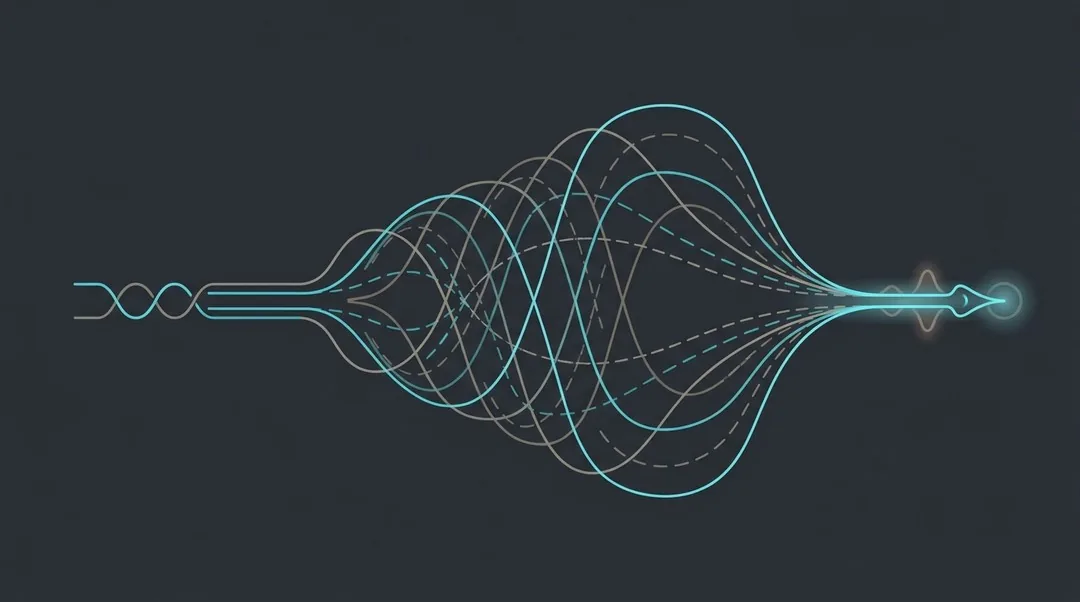
For the first forty years of this story nothing changed about the wire. The same pair of copper ran from a house to an exchange in 1962 and in 1998, and everything that got faster got faster by using that pair more cleverly. Then one decision changed what the pair was allowed to carry, and the speed went up by three orders of magnitude in a decade.
This page is the whole progression, with the arithmetic that explains each jump and the one number that says where dial-up had to stop.
The unit that actually mattered
Bits per second is the number on the box. Characters per second is the number you lived with, and the two are not the same because of framing. An asynchronous line wraps every byte in a start bit and a stop bit, so a character costs ten bits rather than eight and you keep eighty percent of what you paid for. The error-correcting protocols that arrived with the faster modems, V.42 and the MNP levels before it, carry bytes in blocks without that per-character overhead, so the same bit rate suddenly delivered a quarter more text.
That is why the table below has a column for it. Thirty characters a second is a number you can read along with. Seven thousand is a number that finishes before your eye reaches the bottom of the screen. Everything between is the story.
The dial-up ladder
Every rung here is a modem holding a telephone call open. It has to sound like a voice to the network, because as far as the network is concerned it is one.
| Standard | Year | Bits/s | Chars/s | How |
|---|---|---|---|---|
| Teletype, Bell 101 | 1958 | 110 | 10 | FSK, and two stop bits because a mechanical printer needed the time |
| Bell 103 | 1962 | 300 | 30 | FSK, two tones per direction, 200 Hz apart |
| Bell 212A | 1976 | 1,200 | 120 | Phase-shift keying: 600 symbols a second carrying two bits each |
| V.22bis | 1984 | 2,400 | 240 | QAM, four bits per symbol at the same 600 symbols a second |
| V.32 | 1984 | 9,600 | 1,200 | Echo cancellation, so both ends use the whole band at once |
| V.32bis | 1991 | 14,400 | 1,800 | Trellis coding: redundancy that buys back noise margin |
| V.34 | 1994 | 28,800 | 3,600 | Measures the line first, then picks a symbol rate to suit it |
| V.34 annex | 1996 | 33,600 | 4,200 | The practical ceiling of an analogue voice channel |
| V.90 | 1998 | 56,000 down | 7,000 | Stops pretending the network is analogue |
| V.92 | 2000 | 56,000 / 48,000 | 7,000 | Faster handshake, and upstream improved |
Why the jumps stopped being about tones
The first two rungs move a tone about. After that nobody adds tones, because adding tones is not where the room is. What every later standard does instead is carry more bits per symbol, and then fight the consequences.
A symbol is one decision the receiver has to make. Send 600 a second and pick between four possible states each time and you have 1,200 bits per second; pick between sixteen states and you have 2,400. The catch is that sixteen states in the same space means the states sit closer together, so it takes less noise to mistake one for its neighbour. Every step up the ladder is buying bits with noise margin, and the entire second half of the ladder is about finding somewhere else to get that margin back: echo cancellation to use the whole band in both directions, trellis coding to spend some of the new bits on redundancy, and finally measuring the actual line rather than assuming a nominal one.
The number that ended it: about 35,000
A telephone channel gives you roughly 3,000 Hz of usable bandwidth and, on a decent line, something like 35 dB of signal to noise. Shannon's theorem turns those two figures into a hard ceiling on how much information the channel can carry, no matter how clever the modem is, and for those numbers it lands at about 35,000 bits per second.
Which is why V.34 stops at 33,600 and not somewhere rounder. It is not a committee's choice or a marketing figure. It is the wall, approached about as closely as engineering can approach a wall, and no amount of further cleverness inside the voice channel was going to get past it. Every dial-up modem after that point had to stop respecting one of the assumptions.
How 56k got past a limit that was real
By the late 1990s the telephone network was digital almost everywhere. Your call was converted to digital samples at the exchange, carried as numbers, and converted back near the far end. The 35,000 bit ceiling applies to an analogue channel, and most of the path had not been analogue for years.
V.90's trick is to notice that an internet provider is not at the end of an analogue line at all. It sits on the digital network directly. So downstream there is only one conversion to survive, the digital-to-analogue one at the exchange nearest you, and if the modem knows exactly what the telephone company's converter does it can choose signals that land precisely on the values that converter produces. It is not modulating a tone any more, it is picking numbers.
Upstream has the conversion that does the damage, which is why V.90 is asymmetric: 56k down and 33.6k up. Going up, your modem puts an analogue signal on the loop and the exchange digitises it, and the quantisation noise of that analogue-to-digital step is exactly the noise floor the older ceiling was computed against. Going down there is no such step in the network at all — the exchange only converts digital to analogue, and your own modem chooses how to sample what arrives. So the condition is that the path holds no analogue-to-digital conversion in the downstream direction, which is why two modems calling each other directly never got 56k, and why some houses simply could not have it.
The same copper, once nobody had to phone anybody
Here is the assumption that everything above shares, and it is worth stating on its own because breaking it is the whole next chapter. A modem has to survive as a telephone call. That means living inside the band the network reserves for a voice, roughly 300 Hz to 3,400 Hz, because anything outside it is filtered away as not being speech.
The copper was never the limit. A twisted pair from a house to an exchange will carry megahertz. It was the telephone system's own filtering, present because the pair was carrying a conversation, that confined a modem to three kilohertz of it. Stop routing the signal through the voice network and the same wire has hundreds of times more room.
DSL, and why it is asymmetric on purpose
A DSL modem puts data on the same wire above the frequencies a telephone uses, which is why a splitter can separate them and why the line still rings. It divides its spectrum into hundreds of narrow subcarriers, measures each one, and loads more bits onto the clean ones and fewer onto the noisy ones. That is the same idea as V.34's line probe carried to its conclusion: do not assume a channel, measure it, then use exactly what it turned out to be.
The asymmetry in ADSL is a choice rather than a limitation. Higher frequencies fade faster along a copper pair, so the usable spectrum shrinks with distance, and the designers gave most of what there is to the direction people used. It is also why your neighbour got a better rate than you: on DSL the distance to the exchange is the specification.
Cable, which was never a telephone line
Cable started from the opposite end. A coaxial network was built to carry dozens of television channels, so it had enormous bandwidth and no history of assuming anybody was talking. DOCSIS took a slice of that spectrum for data, and later versions took more slices and bonded them together, which is why cable rates climbed in steps that look like multiples rather than the careful percentage gains of the modem years.
Its trade is different too. The pair of copper to a house is yours; a coaxial segment is shared with the neighbourhood. That is the origin of the evening slowdown, and it is a capacity question rather than a distance one.
Is fibre actually the fastest? Not at everything
For capacity, yes, and not narrowly. Nothing else in the running is close, and the limit on a home fibre connection is the equipment at each end rather than the glass.
For latency, no, and the reason is the same physics that makes fibre work. Light is slowed by the material it passes through, and silica slows it to about two thirds of its speed in vacuum, which works out near 5 microseconds per kilometre. Air barely slows it at all. So a microwave link across the same straight line arrives sooner than glass does, and that is not a marginal effect: it is roughly a third of the travel time. Anybody who cares enough about milliseconds to pay for them, which in practice means people trading financial instruments, has known this for years and buys radio paths rather than fibre.
The route matters as much as the medium, and in the same direction. Fibre follows roads, railways and rights of way, so the cable between two cities is meaningfully longer than the line between them. A radio path goes straight. Two separate advantages, both pointing away from glass, for the one application where arriving first beats carrying more.
Which is what hollow-core fibre is for. Guide the light down a channel of air rather than through solid glass and you get most of the capacity of a fibre with propagation close to vacuum: about 3.46 microseconds per kilometre against silica's 5. It is a good illustration of where this whole story ends up. For forty years the engineering was about extracting more from a fixed channel. Now the channel is so generous that the interesting remaining problem is not how much it carries but how fast the light gets there, and the answer turns out to be to take the glass out of the way.
Fibre, where the constraint stops being the medium
Glass does not have the problem. A fibre's usable bandwidth is so far beyond what is being asked of it that the limit moves entirely to the electronics at each end and to how many houses share one strand. A passive optical network splits one fibre from the exchange among a group of homes, so a generation is described by the total it carries and the way that total is divided.
Which closes the loop with the top of this page. For forty years the engineering was about extracting the last bit from a channel that was fixed and hostile, and every gain came from understanding that channel more precisely. On fibre the channel stopped being the interesting part. The Shannon limit is still there. It is simply so far away that nobody designing a home connection has to think about it.
What each one felt like
The same file, moved at each speed. A megabyte was a large download in 1985 and is a photograph now, which is most of the point.
| Speed | A screen of text | 1 MB | A 3 minute song |
|---|---|---|---|
| 300 bits/s | 64 s | 9.7 hours | 13 days |
| 2,400 | 8 s | 73 min | 1.6 days |
| 14,400 | 1.1 s | 9.7 min | 5.2 hours |
| 56,000 | 0.3 s | 2.5 min | 1.3 hours |
| 8 Mbit ADSL | instant | 1 s | 30 s |
| 1 Gbit fibre | instant | 8 ms | 0.24 s |
Text at 300 bits per second and a song at a gigabit are separated by a factor of about three million. The wire in the first row and the wire in the fourth are the same wire.
Sources
- Shannon, “A Mathematical Theory of Communication” (1948), for the ceiling on a voice channel and why 33.6k is where it stopped.
- ITU-T V.34 and V.90, the recommendations themselves rather than their catalogue pages. V.34 defines line probing as “A method for determining channel characteristics by sending periodic signals” and is titled for “up to 33 600 bit/s”; V.90 is titled for “up to 56 000 bit/s downstream and up to 33 600 bit/s upstream”, which is the asymmetry this page describes.
- ADSL and VDSL2, for the spectrum each is allowed and the distance trade.
- DOCSIS and passive optical networks, for the shared-medium generations.
- Optical fibre and hollow-core fibre, for 5 microseconds per kilometre against 3.46, and why latency and capacity are different questions.
- The engineering notebook on this site, for the Bell 103 measurements and the handshake timings.
Back to the modem · What was on the other end · The walled gardens